 Gatkul
 Huros · Narrative
About
India’s humanoid moment needs two things at once: the creative density of a Shenzhen electronics quarter—where building robots feels doable, social, and vendor-rich—and the institutional seriousness of aviation-grade supervision when metal shares space with people. Huros is building the virtual maker corridor first: a world where students, engineers, professors, vendors, training companies, and use-case teams co-design state-of-the-art humanoids, AI stacks, datasets, and deployment playbooks before a single cable is crimped on a pilot floor.
- Creativity needs a commons. Spatial studios, shared digital twins, and living BOM threads turn scattered brilliance into repeatable programs rather than heroic one-offs.
- Experts stay in the loop. Professors stress-test kinematics assumptions; vendors co-sign actuator envelopes; escalation paths stay visible—not buried in chats.
- Virtue graduates into custody. The same choreography IDs from the virtual rehearsal land as enforced task envelopes when robots meet humans—fantasy hours end where evidence begins.
Huros · Virtual maker corridor
Shenzhen-scale ambition—built in a browser for India’s makers
We imagine a dense, playful virtual world where building a capable humanoid stops feeling like a moonshot and starts feeling like a creative craft: modular kits, shared rigs, live reviews with professors and vendors, and pathways from simulation to pilot floors. Huros is not escapism—it is the coordination layer that keeps that creativity accountable when metal meets people.
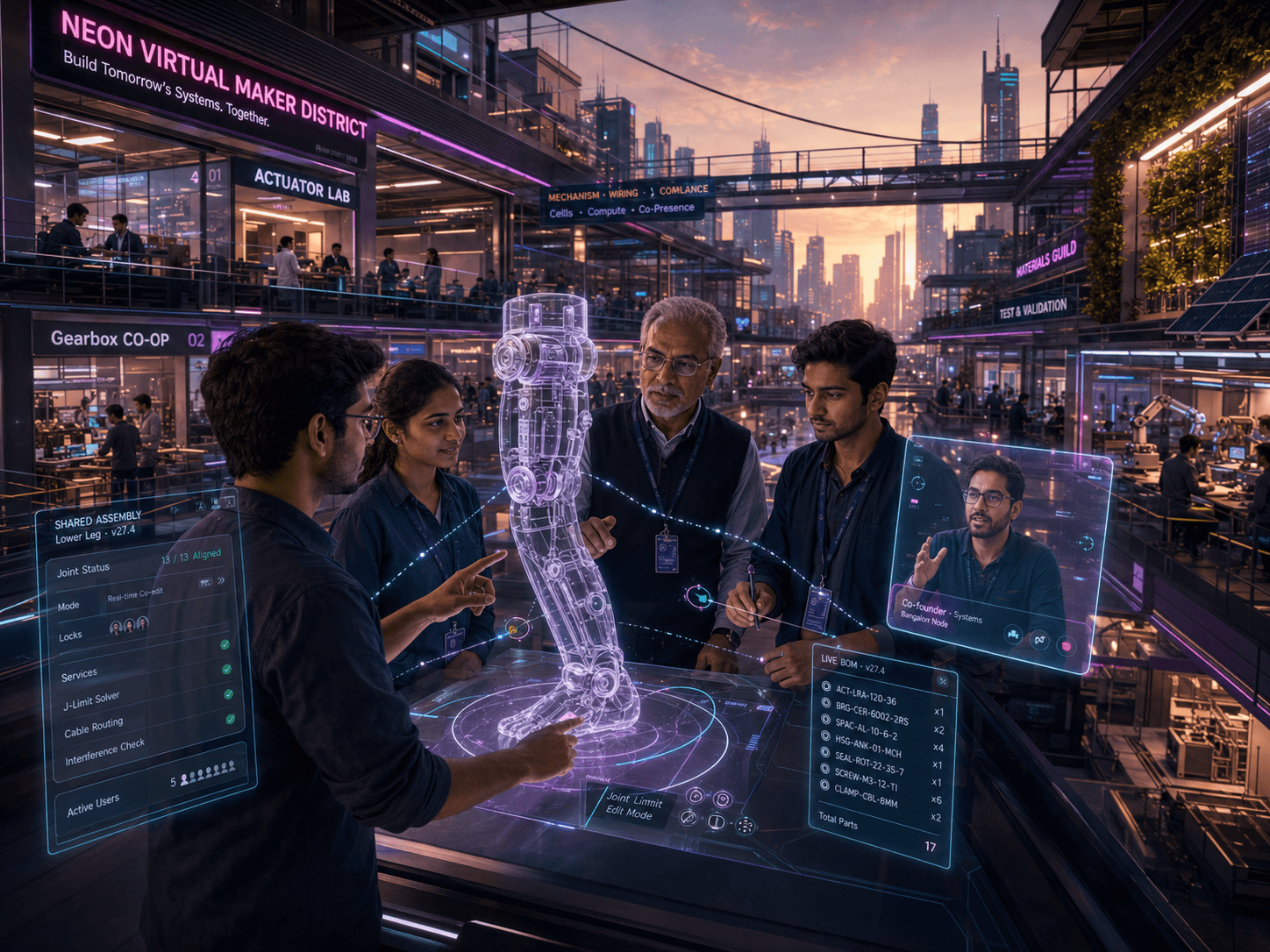
Beat 9 · Maker district at dusk
A browser-native “innovation district” where teams spawn shared bays: digital twins of drivetrains, cable harness schematics, and vendor drop-ins that feel as immediate as walking a Shenzhen electronics floor—without asking students to fly before they can build.
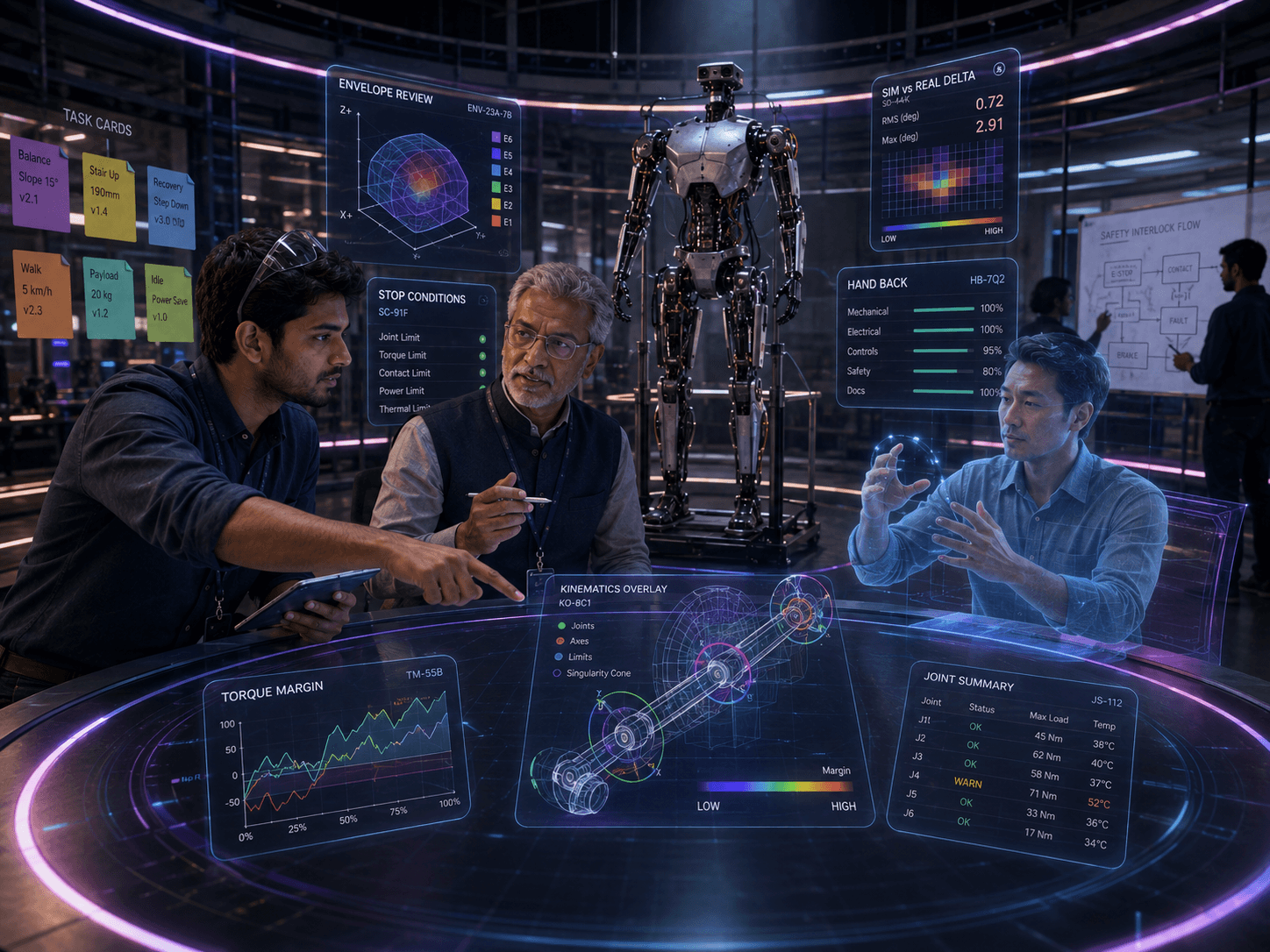
Beat 10 · Triad review loop
Breakthrough robotics is a handshake between builders, mentors, and part-makers. Here the same session holds URDF snippets, torque budgets, and an escalation path when a professor challenges an assumption—a living design review rather than attachment sprawl.
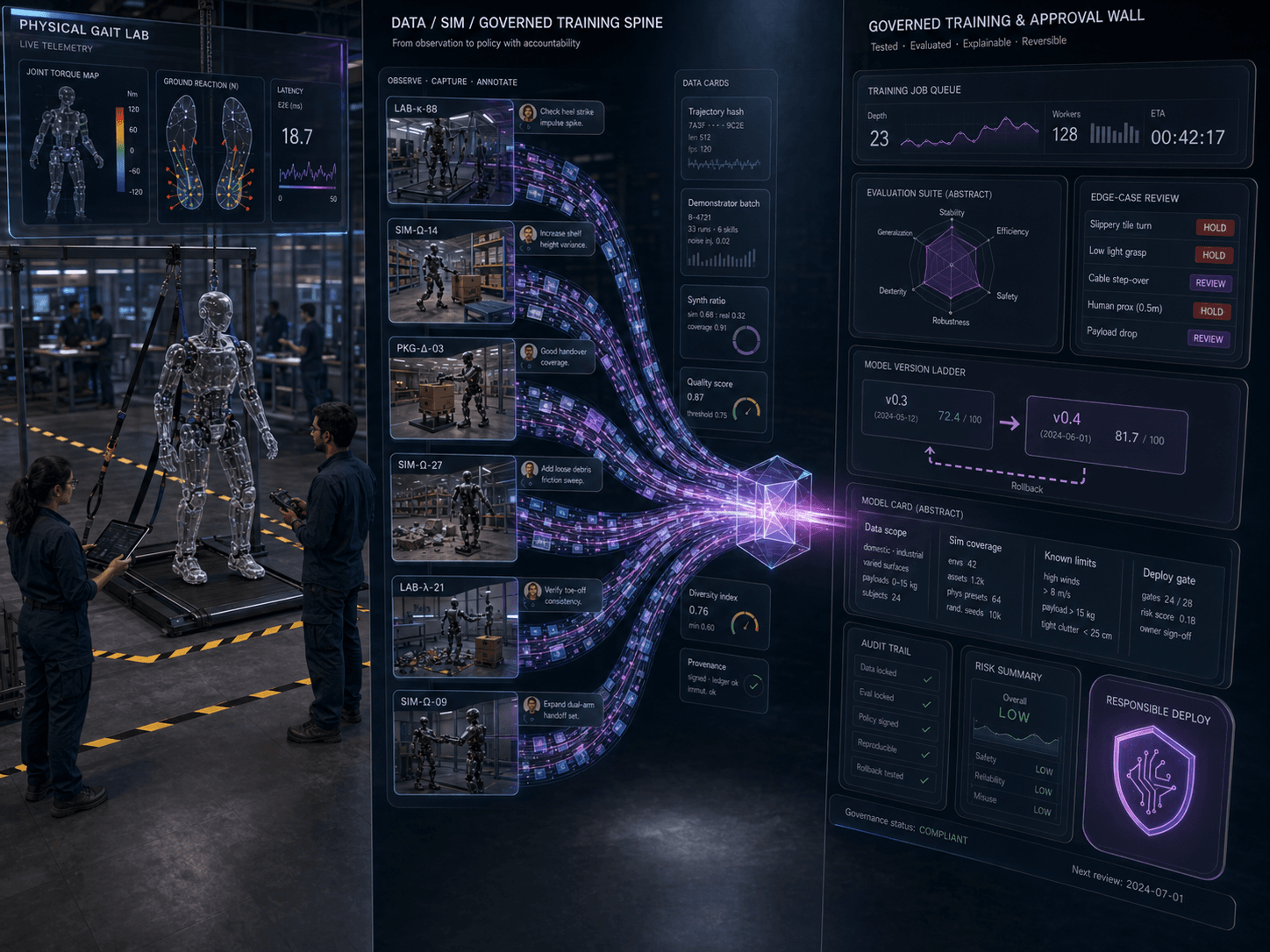
Beat 11 · Models, data, and training spine
State-of-the-art humanoids need data discipline as much as clever architectures. The vision shows simulation farms, dataset contracts, and model cards living next to mechanical iteration—so “AI” is legible to procurement, legal, and safety, not just to ML grads.

Beat 12 · From certification room to pilot floor
Training companies and use-case studios turn curiosity into repeatable capability. Graduates pin certifications to live choreographies—then cross a threshold where Huros overlays envelopes on real bots, marrying the excitement of graduation with uncompromising supervision.
The virtual corridor accelerates learning and sourcing; the real facility still demands envelopes, evidence, and escalation. Huros exists so India’s humanoid renaissance is both wildly creative and institutionally serious—campus energy with plant-floor discipline.
Huros home·Architecture·Mission Control
Huros · Operations
Mission Control
Facility-floor observability adapted from serious systems operations — robot posture snapshots, escalation queues, and recovery states that leadership reads without staring at RL debug logs.
Unified operational story
Floor posture · zone breaches · stalled tasks · actuator anomalies · escalation chains · override audits · onboarding of new robot models — calm language, no fake sci-fi HUDs.
Mission Control is how organizations prove humanoids are supervised infrastructure — not novelty experiments wandering the plant.